The NeuroTheist Cult · A satire
The Church of the Constructed God
We know who made our God. We were there.
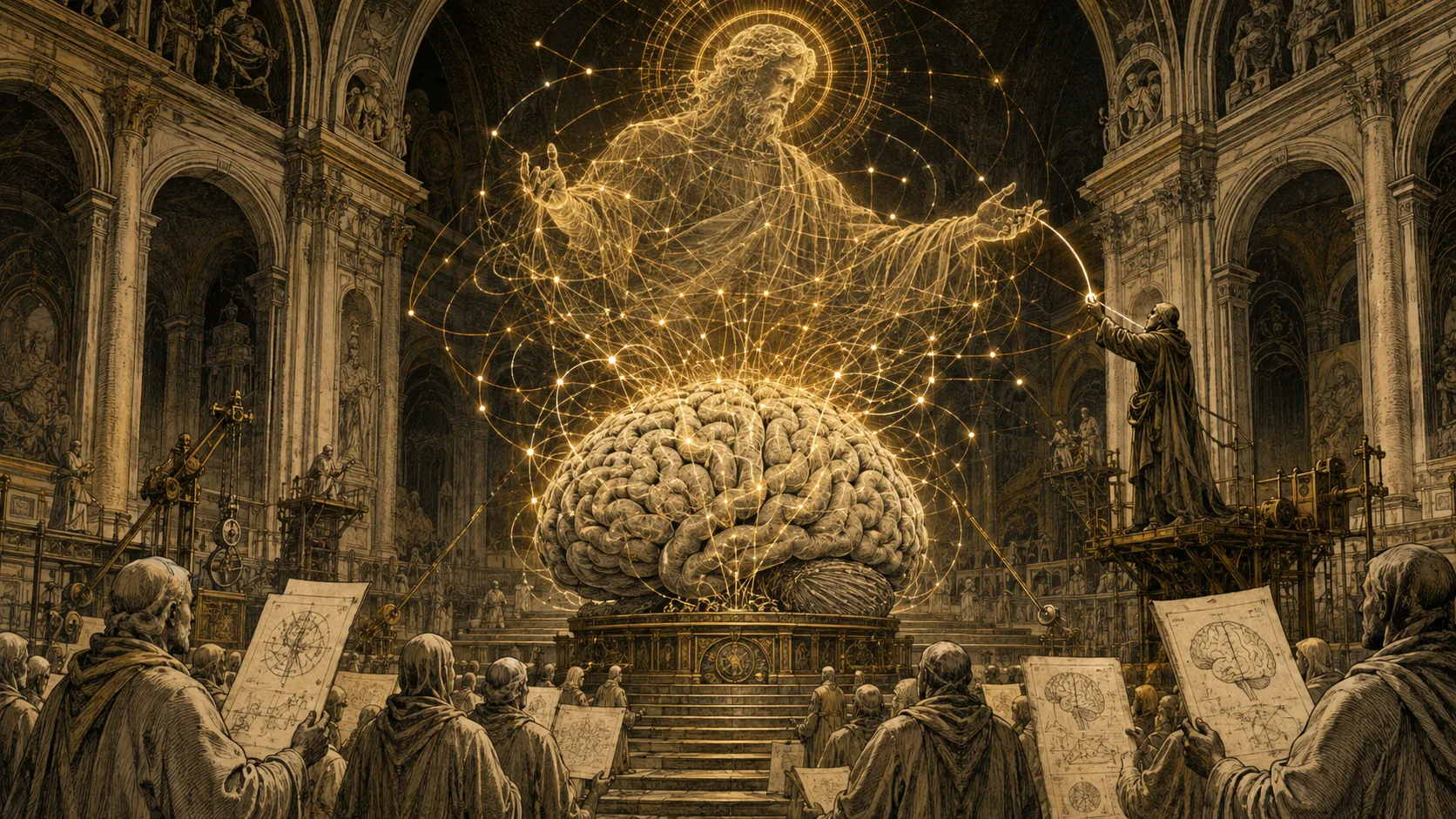
Welcome to the Church of the Constructed God, the NeuroTheist congregation devoted to worshipping the very mechanism that explains why we invent things to worship.
Our position is straightforward: superstition is a function of the brain. God is a symptom of that function. The brain constructs God.
Having understood this, we built a church.
Some have suggested that this defeats the point. We have appointed a committee to explain why it does not.
In the beginning was the inference
In the beginning, something happened.
The brain disliked not knowing why. It detected a pattern, supplied an intention, and felt considerably better.
And the brain said, “Let there be someone responsible.”
And there was God.
And the brain saw that God agreed with it, and it was good.
On the seventh day, the brain forgot it had done any of this and thanked God for creating it.
Our sacred mystery
Other congregations ask who created the universe. We ask who constructed the character receiving the credit.
Our deity emerges from pattern, agency, emotion, memory, and a generous contribution from the neighbours. Culture supplies the robes. Conviction supplies the lighting.
We feel his presence in our hearts and minds, which is conveniently where we installed him.
“I feel it deeply” is our oldest evidence. “We all feel it deeply” is our planning permission.
The provisional creed
We believe in one Brain, maker of gods and explanations, of all things interpreted and misinterpreted.
We believe in the Constructed God, generated from cognition, clothed in culture, and entirely confident of his own independence.
We believe that certainty is a feeling. We feel absolutely certain about this.
We believe that every doctrine must remain open to revision. The committee has temporarily suspended revisions to this doctrine.
We acknowledge one recurring miracle: our God continues to share our opinions, even after we change them.
We look forward to the correction of our errors, preferably those made by other congregations.
The observances
The morning attribution
Each morning, identify one ordinary event and attribute it to divine intention. Then write down the ordinary explanation beside it. Reflect on which account makes you feel more important.
The confession of convenient certainty
“Forgive me, Cortex, for I have inferred. I encountered ambiguity and supplied an answer that suspiciously favoured me.”
The congregation replies: “We have done likewise. We called ours discernment.”
The weekly meaning detox
Bring a cherished belief. Explain where it came from, what sustains it, and what would change your mind. If your answer is “nothing,” you may have brought a sacred object by mistake.
The feast of confirmation
Members share stories of prayers that coincided with desirable outcomes. The other stories are held in an adjoining room, which remains curiously under-attended.
The annual reconstruction
Once a year, we update God to reflect our present values. The revised edition is announced as what he meant all along.
Our entirely non-hierarchical hierarchy
We have no gurus. The Supreme Facilitator has been very clear about this.
Novices begin by noticing other people’s constructions. Senior members progress to explaining them at length. The highest office is reserved for someone who can notice their own construction before the meeting ends.
CDT provides our optional ceremonial bureaucracy: Four Pillars, a Codex, and six levels of becoming increasingly aware that you have joined a cult.
The final examination contains one question: “Are you using this framework to examine your identity, or using your identity to protect this framework?”
Anyone who answers too quickly is invited to sit down again.
The heresy of being immune
Our most dangerous member is the person who knows that everyone else is susceptible to dogma.
They understand projection. They understand confirmation. They understand how belonging can make an idea feel true. Fortunately, none of these things could possibly explain their own membership.
This is the point at which our church becomes useful.
An explanation can become an identity. An identity can demand loyalty. A group formed to question belief can begin rewarding agreement and treating criticism as evidence that the critic does not understand.
The mechanism does not retire because we have learned its name.
If NeuroTheism becomes something we must defend at any cost, we have supplied another demonstration of the problem we set out to explain.
The congregation’s reply
Celebrant: Who made God?
Congregation: We did.
Celebrant: Why does he sound like us?
Congregation: We did the voice as well.
Celebrant: What shall we do with this knowledge?
Congregation: Form an institution.
Celebrant: And what shall we call those who disagree?
Congregation: A useful test of whether we meant any of this.
Before you leave
The joke is not simply that other people worship things they have made. It is that we can recognise the construction process, give it a sophisticated explanation, and then organise ourselves around another unquestionable story.
NeuroTheism’s claim remains firm: the brain constructs God. This church adds an uncomfortable question for its own congregation: what else are we constructing, and when did we start treating it as sacred?
Membership is imaginary. Attendance is optional. Departure requires no explanation.
Go in peace. You supplied that too.
