Neurotheism: How the Brain Constructs God
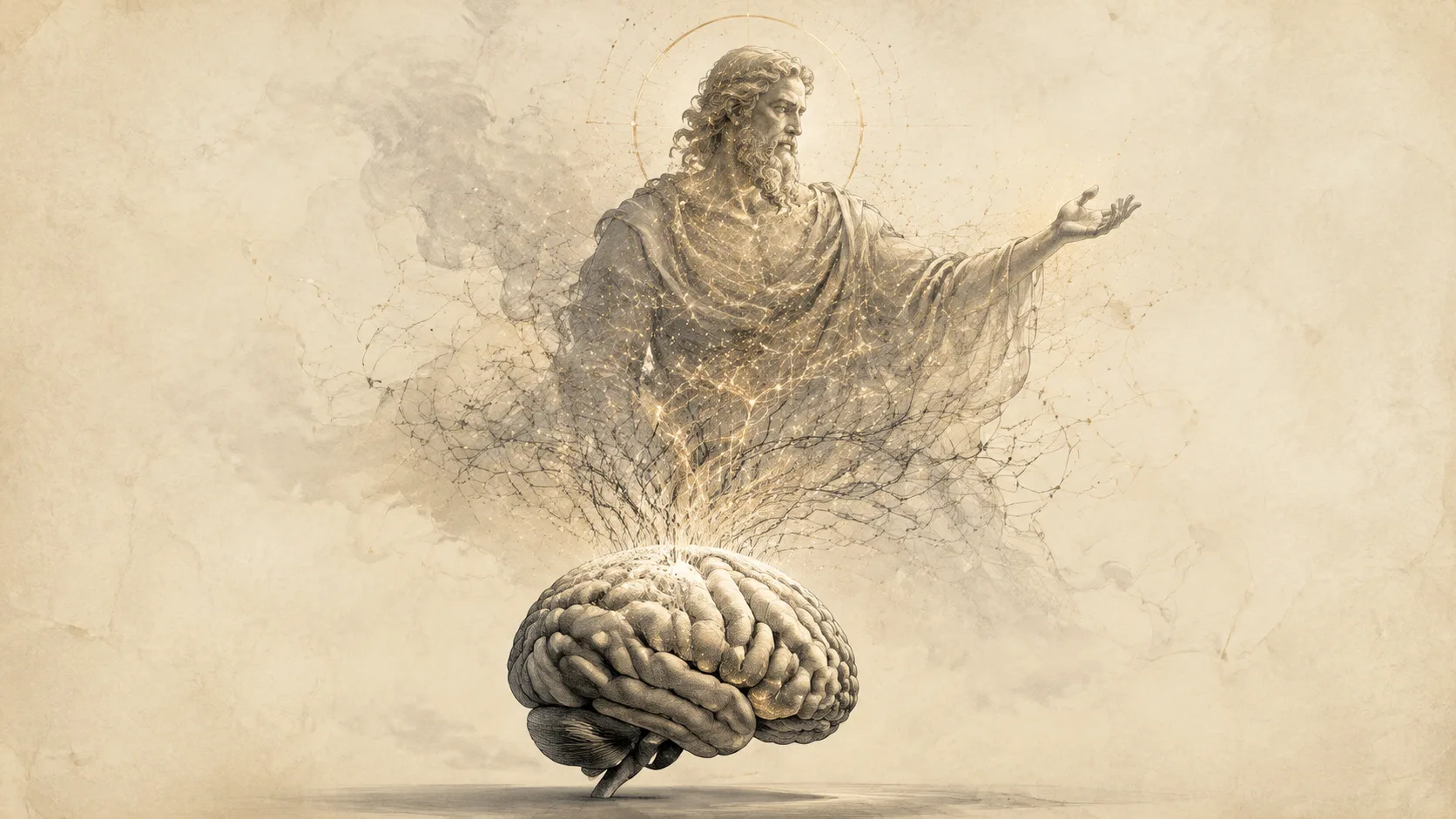
Superstition is a function of the brain. God is a symptom of that function. The brain constructs God.
This is the Neurotheist position: a causal explanation of how human beings generate gods, experience them as real, and give them authority over their lives.
Why I developed Neurotheism
I coined Neurotheism because I am bored of the tired back and forth between atheists and theists. One asserts that God exists; the other rejects the assertion. I want to understand the process that produces the assertion in the first place.
The term is deliberately tongue-in-cheek. It names an investigation into the science of belief and the neuroscience of superstition, while anticipating what I believe that investigation will do to religion. My expectation is that, as we uncover how brains construct gods, those gods will lose their authority and eventually cease to exist as objects of belief.
My starting point is that belief without evidence is superstition. More specifically, I am concerned with the processes through which people attribute connections, causes, and intentions beyond what the evidence warrants. Religious belief gives these constructions names, personalities, histories, and institutions.
From the effects of religion to the construction of belief
Most debates about religion begin by asking whether God exists, whether belief is rational, or whether religion is good for society. My question concerns the mechanism underneath those debates: how does a brain produce belief in the first place?
I distinguish three questions to make the direction of inquiry clear. These are differences of emphasis, rather than rigid boundaries between research fields:
- What does religion do to the brain? Research into prayer, meditation, ritual, mystical experience, and religious practice examines their relationship to neural activity and subjective experience.
- Why do humans adopt religious beliefs? Psychological explanations examine motivation, fear of death, attachment, social cohesion, moral regulation, and existential comfort.
- How does the brain generate belief itself? Neurotheism places the construction process at the centre of the explanation.
My original distinction was that neurotheology examines how religion affects the brain, while Neurotheism examines how the brain affects religious belief. The point of that reversal is to make the brain’s productive role explicit. Religious experience is the phenomenon to be explained; invoking a god does not explain the mechanism that generates it.
Motivation, evolution, and culture remain part of the inquiry. They help explain why a construction arises, why it becomes compelling, and how it survives. The central task is to explain how the construction is made.
Belief as construction
In the account I am advancing, the brain actively constructs models of the world. It predicts, fills gaps, resolves uncertainty, assigns agency, and organises experience into meaning. Belief, in this sense, is something we build.
Neurotheism holds that the capacities through which we construct self, purpose, intention, narrative, and value also construct gods. Religious belief is an expression of this ordinary cognitive architecture.
From my Constructed Development Theory perspective, we understand experience through cognitive heuristics—what I describe elsewhere as Cognitive Intentions—which shape interpretation in the moment. God, in this account, is generated. The believer experiences the resulting construction as a discovery or revelation.
My developmental claim is that, under certain cognitive and developmental conditions, this production becomes inevitable: a mind seeking agency, coherence, and meaning in uncertainty generates explanations that exceed the evidence. This treats religious belief as an intelligible product of cognition, rather than dismissing believers as childish.
Superstition and the evolutionary trade-off
One proposed evolutionary route to superstition begins with the costs of getting an inference wrong. Mistaking a noise for an agent can be less costly than failing to detect an actual threat: better safe than eaten. A tendency to infer agency could therefore be useful while also producing false positives.
Pattern recognition and the tendency sometimes described as hyperactive agency detection offer candidate ingredients in this account. They help frame the question of how brains supply intentions to ambiguous events and how such inferences become beliefs about spirits, fate, or gods.
The Neurotheist argument is that useful cognitive capacities can produce unwarranted beliefs, and that those beliefs can become entrenched as cultural systems. An evolutionary advantage in a capacity does not guarantee the truth of every belief it produces. The evolutionary explanation is a proposal about origins; the experimental findings below address components of the construction process.
The evidence for construction
I am proposing a causal explanation: superstition arises from the brain’s operations, and gods are constructions of those operations. The case rests on converging evidence about how people generate causal beliefs, experience unseen presences, and attribute minds and intentions to gods.
The strongest argument is that we can identify, and sometimes experimentally manipulate, components of the process that constructs a god.
1. The mind generates meaningful connections where none exist.
Whitson and Galinsky’s experiments found that inducing a lack of control increased several forms of illusory pattern perception, including superstitious associations. That provides experimental support for a starting point of my argument: people can generate apparently meaningful relationships through their own psychological processes, without a corresponding relationship in the world. Whitson & Galinsky, 2008
In Neurotheist terms, the proposed progression is: an event happens; the mind attributes significance or causation; that attribution becomes a belief. An intentional supernatural cause is a further construction upon that foundation.
2. The brain can produce the experience of an external presence.
Blanke and colleagues induced a feeling of another presence in healthy participants by introducing conflicts between movement and sensory feedback using a robotic apparatus. Participants’ own bodily signals contributed to an experience attributed to someone else. Blanke et al., 2014
This matters directly to “I feel God’s presence.” It demonstrates a mechanism by which an apparently external presence can be constructed from internally processed information. The experiment produced a sensed presence, rather than a specific deity; identifying that presence as God is the additional interpretive step my theory addresses.
3. People construct God’s opinions partly from their own.
Across seven studies, Epley and colleagues found that people’s estimates of God’s beliefs closely tracked their own beliefs. More significantly, experimentally changing participants’ own opinions also changed what they thought God believed. Thinking about God’s beliefs and their own beliefs also showed overlapping neural activity. Epley et al., 2009
This is especially useful evidence for my position because it goes beyond locating religious thought in the brain. Changing the person’s outlook changed the attributed outlook of God. It supports a process through which the believer supplies characteristics to the deity.
4. Religious thought recruits ordinary cognitive machinery.
Kapogiannis and colleagues found that dimensions of religious belief recruited established networks involved in understanding intentions and emotions, abstract meaning, and imagery. Their findings support an account in which religious thought draws on capacities used elsewhere in human cognition. Kapogiannis et al., 2009
My claim therefore does not need a single “seat of superstition.” A stronger formulation treats superstition as an outcome of interacting brain functions. The capacity to infer intentions, for example, supplies a way to represent a being who watches, wants, approves, or punishes.
5. Culture helps determine what the construction becomes.
Research across five countries found that culturally shaped understandings of the mind, alongside individual differences in absorption, were associated with reports of sensory experiences of gods and spirits. This supports including cultural learning in the explanation of religious experience. Luhrmann et al., 2021
For Neurotheism, culture supplies names, narratives, and expectations that brains learn and reproduce. “The brain constructs God” need not mean that each brain independently invents an entire religion.
Together, these findings support the following explanatory inference:
Human cognition can generate unwarranted causal connections, construct unseen presences, and supply those presences with intentions and opinions. Cultural learning can organise these constructions into recognisable gods. God is therefore explicable as a product of interacting cognitive processes.
The bridge from superstition to God still needs to be argued rather than built into the definition. Agency detection alone is insufficient: one study found an association with paranormal belief but no association with traditional religious belief. That favours my account being a theory of several interacting processes. Van Elk, 2013
God as a symptom of superstition
Superstition is an outcome of the brain’s capacity to construct connections, causes, and intentions beyond what the evidence warrants. Neurotheism holds that gods are a culturally elaborated expression of this capacity.
The brain supplies the apparent agency, the felt presence, and the conviction; culture supplies the identity and narrative. The resulting construction is experienced as an independently existing being.
In this sense, God is a symptom of superstition: a manifestation of the processes that generate and sustain it. The brain constructs a god and then treats that construction as an explanation of its own experience.
I would defend that as an inference to the best explanation. The studies establish parts of the construction process; my theory joins them into an account of gods. They do not yet establish that this account exhausts every religious belief or experience. That is the specific evidential boundary, not a requirement to give a divine explanation equal standing.
The developmental consequence
Once gods are understood as psychological artefacts, disagreement about them becomes a question about the models people construct, the experiences they interpret, and the authority they give those interpretations. The developmental question is: what kind of brain constructs this particular God, in this particular way, at this particular stage of development?
Neurotheism offers a description of belief formation with critical consequences for religious claims. Explaining why a conviction feels compelling challenges the use of that conviction as evidence of divine authority. Understanding the believer and challenging the belief belong to the same inquiry.
This account relocates meaning from the heavens to the nervous system. It does not require abandoning meaning, identity, or value. It asks us to recognise our role in constructing them and to examine how minds organise reality when faced with uncertainty.
What this could change
Cognitive and developmental education. Teaching children how beliefs form, how interpretations acquire certainty, and how evidence can correct them could strengthen metacognitive awareness and resistance to dogma. The aim is to make the construction process available for examination.
Psychotherapeutic inquiry. My original proposal included understanding religious delusions or attachments through their underlying cognitive and neurological processes. The practical question is how this understanding might help people examine distressing beliefs and attachments. This is a proposed application, not an established treatment, and religious belief by itself is not a clinical diagnosis.
Public discourse. Moving from “Is God real?” to “How does the brain construct God, and what needs does that construction serve?” changes what we investigate. Emotional, neurological, developmental, evolutionary, and cultural explanations become central to the discussion.
The future of gods
My original prediction was blunt: eventually the brain will be mapped, the basis of superstition uncovered, and all gods will cease to exist.
I retain that prediction. By “cease to exist,” I mean that gods will cease to be sustained as independently existing beings in human belief. The construction account places their existence there from the outset.
The mechanism need not occupy a single “seat of superstition.” The evidence points towards interacting processes. Mapping those processes means understanding how the mind generates the presence, agency, emotion, and conviction that it attributes to a god.
My expectation is that, once people understand how this construction works, they will stop mistaking its products for divine beings. Explaining a belief and ending its influence are different achievements; the disappearance of religion is my prediction about the consequences of understanding, rather than a result already demonstrated by the studies.
The central claim does not wait for that future. Superstition is a function of the brain, and gods are culturally elaborated products of that function. The brain constructs a god and then treats that construction as an explanation of its own experience.
God tells us far less about the universe than about ourselves.